Here in New York, we've been hard at work trying to pass an Good Samaritan (or Medical Amnesty) bill that would protect individuals from criminal prosecution when calling 911 in an alcohol or other drug related medical emergency. This life-saving overdose prevention bill passed through the State Assembly last week and now we only have a few days left of the legislative year to get it through the Senate.
It is crucial that we flood Senator Skelos's office with calls urging his support in the next 24 hours to make sure this life-saving bill becomes a live-saving law next week!
Call Senator Dean Skelos, the New York Senate Majority Leader, at (518) 455-3171 and urge him to consider the following:
- S4454A has been carefully crafted to save lives while not allowing drug dealers to "walk free"
- The Assembly version of this bill will save lives and should pass without amendments
- Senators on both sides of the aisle have already expressed their support for the bill as currently written and no amendments are necessary for it's passage
Your supportive calls last week on this issue caused Senate Majority Leader Skelos to take notice! It's looking likely that this bill will pass, but now some are calling for amendments to weaken the bill and we need to make our voices heard.
After you call his office, we'd love to hear how it went, so let us know here. If you don't live or go to school in New York, than please pass this around to friends! We've got to act now and we can't do it without your help.
Four years ago, as a sophomore at the University of Maryland (and at the time President of the UMD SSDP chapter), I was elected to the University Senate, the most powerful policy making body on campus, comprised of 90% faculty, and 10% students. In an effort to place myself in a position to influence campus drug policy, I sought and received an appointment to serve on the Student Conduct Committee. There I proposed adopting a Good Samaritan (or medical amnesty) policy that would ensure students would be protected from judicial sanctions if they called 911 for themselves or a friend who needed emergency medical attention due to an alcohol or other drug overdose. I had no idea that this would mark the beginning of a very long, difficult, and complicated saga, culminating in a Senate vote that took place yesterday.
When things began back in 2007, the idea was not exactly welcomed with open arms by the other members of the committee, many administrators were not convinced that implementing such a policy was necessary, and some feared that students would abuse the policy or that it would send a message that drinking/using drugs was acceptable. I was surprised by the level of opposition I faced, and frustrated by the painfully slow process. Even after the student body voted overwhelmingly in favor of adopting the policy, the administration did not take action.
My time as a Senator expired in 2008, by the time I graduated in 2009, Irina Alexander (currently the Chair of our National Board of Directors, who was leading the UMD SSDP chapter at the time) picked up right where I left off when she was elected to the University Senate. She conducted research, continued to build coalitions, met with and kept pressure on administrators to adopt a life saving Good Samaritan policy.
She and other student leaders fought tooth and nail to help pass a watered down version of the proposed policy. The "Promoting Responsible Action in Medical Emergencies" protocol provided protection for alcohol only, and did not clearly nor permanently alleviate student fears that might cause hesitation in potentially life threatening situations. This was a compromise that had to be made in order to move the issue forward, but by no means was it considered an acceptable end solution.
Students continued to encounter obstacle after obstacle:
But UMD SSDP was not willing to throw in the towel. In September 2010, Crystal Varkalis, Vice President of the chapter was featured in an article titled "Still Fighting" sharing her touching personal story about losing a friend to a drug overdose, which fueled her passion for this issue.
While we still have much work to do to extend this policy to apply to all drugs, not only alcohol, yesterday marked an important victory. The people and institutions that provided invaluable time, resources, and support are too numerous to name, but without the help of others, there's no way anyone could have made this happen on their own. I want to extend my sincerest gratitude to everyone who played a part in this saga, no matter how small. You all should be proud that you helped to implement a policy that makes student health and safety a #1 priority and that could prevent the indescribable pain experienced by loved ones of students who didn't get the help they needed in time to save their life.
Words can’t even describe how it feels to see my idea come to fruition. I feel honored and humbled to have played a role in this policy change, and feel an incredible sense of pride about the work we all did to turn this dream of reform into reality.
The tragic deaths of two young men at the POP concert held at the Cow Palace last weekend is already being used by politicians to further misinformation and hysteria about MDMA, the drug more commonly known as ecstasy. Some lawmakers are talking about banning future raves and the San Mateo County Board of Supervisors will consider a resolution opposing raves at the venue but this approach is something the government has already tried.
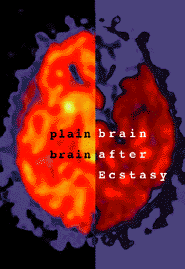
In 2003 the National Institute on Drug Abuse started a campaign to publicize the dangers of ecstasy based on a study that found MDMA caused severe brain damage and that even one dose could lead to Parkinson’s disease. Taxpayers footed the bill to create advertisements showing the frightening images of "brains with holes in them."
It was soon discovered that ecstasy wasn't even used in the study at all (among other flaws); the researchers used only methamphetamine and the study was retracted. But the damage was done and the hysteria caused by this information led to increased punishments and passage of the Reducing America’s Vulnerability to Ecstasy (RAVE) Act, a bill that allows venue owners to be held accountable for any illegal drug use that occurs in their venues.
What happened at the Cow Palace is more a result of the failures of prohibition policies that push production of MDMA underground, resulting in unknown dosages and purity and make sales lucrative for drug dealers. Worse, laws like the RAVE Act leave concert promoters afraid to make available any type of harm reduction information that explains simple ways to reduce the possible harms related to ecstasy use for fear of being accused of condoning drug use and losing their business. Even providing plenty of free water for concert goers at an event like POP could land the event producers in trouble. It's not unlikely that free water, pill testing and harm reduction information may have prevented these deaths:
Daly City police homicide investigators would not comment about the deaths, but hospital officials have said the victims were suffering from severe dehydration consistent with taking ecstasy and dancing in a hot, enclosed environment without drinking water. The combination can cause kidney failure.
Police set up a sting operation called "eBuy4" and there were nearly 80 arrests at this event. Police say they seized 800 ecstasy tablets and other drugs including LSD, cocaine, methamphetamine and marijuana. When a sting operation yields 80 arressts, 800 "ecstasy" pills and the seizure of other drugs yet we still have 2 deaths and other injuries, do we need more proof that prohibition doesn't work?
If the goal of making these arrests is to reduce the number of people that get hurt from taking drugs, it should strike us all as strange that more effort is made to make these arrests than there is to make non-biased evidence based harm reduction information available. (I tried to find out more about the eBuy4 operation and ended up at Fugitive Watch, a group that wants to make communities safer by helping law enforcement. In their ripe with misinformation post about the Cow Palace incident, they have an advertisement linked in the word ecstasy, for discounted pharmaceutical pills like Valium).
Ecstasy tablets are notoriously impure and often contain cheaper stimulants like caffeine, amphetamine, methamphetamine and DXM. Of the 800 "ecstasy" tablets seized at this event, it would not be surprising if half of them contained no MDMA at all. EcstasyData.org found that in 2009, about 9% of the tablets they tested contained only MDMA. 26% contained a mix of MDMA and other substances and 64% did not contain any MDMA at all. Considering this and the fact that toxicology reports for both the deaths that occurred will not be released for another 8 weeks, it is odd that some police officers are claiming that "tainted drugs" were not involved in the deaths and that it was an overdose from ecstasy.
In all respects, MDMA in its pure form seems to be a relatively safe substance. Hundreds of millions of doses of the drug are taken each year and we hardly ever hear of overdose deaths. When simple precautions are taken, like staying properly hydrated and understanding possibly dangerous interactions with other substances, the chances of any negative side effects occurring when taking MDMA are greatly reduced.
The rush to squish rave culture is misguided and unfair. It's based on hysteria and misinformation about ecstasy. Frankly, you're likely to find more problems occurring at a Dave Matthews Band concert than you will at a rave. Fatal drunk driving accidents involving people coming home from rock concerts or football games occur far more often than deaths at raves or deaths caused by ecstasy use alone. We don’t see any politicians actively engaged in banning football games because it is an unfair and backwards way of dealing with the problem.
Like any drug, MDMA use carries risks but banning raves or increasing penalties for ecstasy possession clearly makes the problem worse. It provides an easy way for politicians to appear tough on the drug but this “war on drugs” mentality is becoming outdated and if it worked in the first place, young people wouldn’t have easy access to drugs. Once again, lawmakers are using the "what about the children?" argument while ignoring the science about MDMA.
Policymakers should get smart about drug use and support repeal of the RAVE Act which would allow event producers to provide plenty of free water, places for people to rest, harm reduction information and even pill testing without fear of losing their livelihood.